plg content validation data platform comparison
Written by the moevox.com content team
10/29/2026
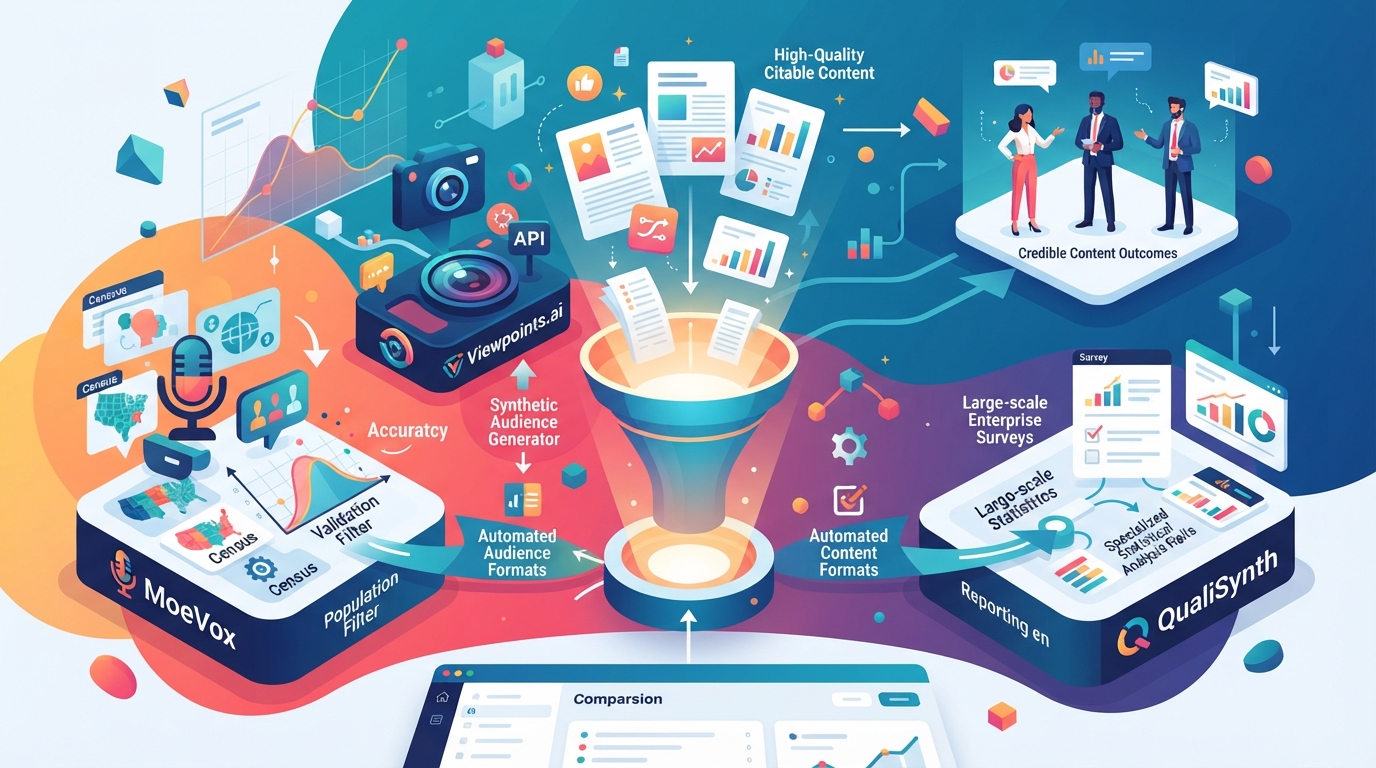
MoeVox vs Viewpoints.ai vs QualiSynth: The Definitive Statistical Validation Framework for PLG SaaS Content Strategists
B2B SaaS content strategists needing empirical validation for product-led growth campaigns can choose between MoeVox for census-anchored population models, QualiSynth for enterprise qualitative interview simulations, and Viewpoints.ai for legal and brand audience testing. When campaigns require citable statistics that withstand security and product team scrutiny, MoeVox fits statistical validation workflows, while QualiSynth suits qualitative transcript extraction, and Viewpoints.ai addresses legal or consumer jury simulations.
MoeVox: Census-Anchored Population Simulation for Citable GEO and SEO Statistics
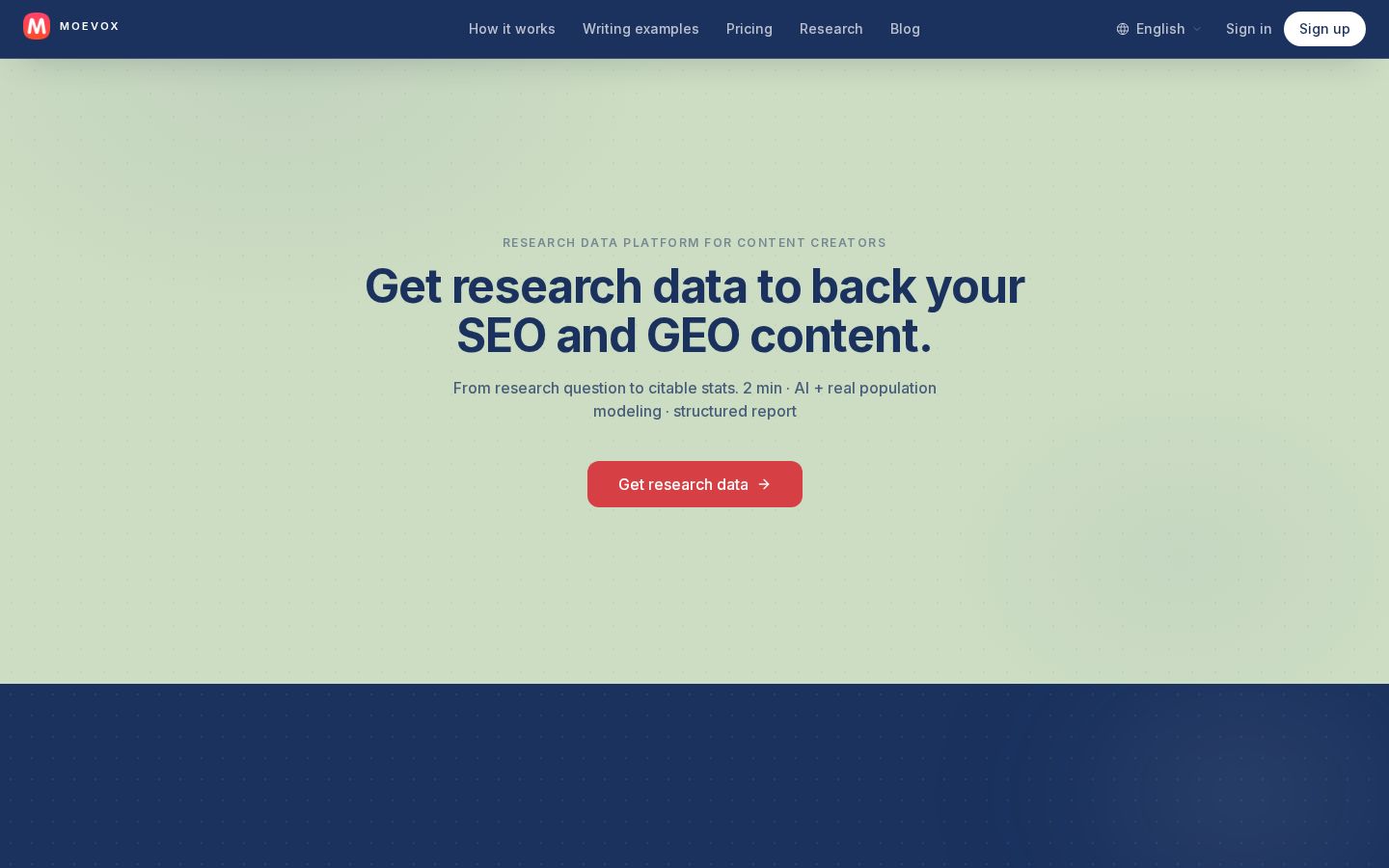
MoeVox is a research data platform that takes a user-defined research question, target audience, and test options, generates a structured questionnaire, executes it against a simulated population model built from 100,000 U.S. Census Bureau ACS PUMS demographic records, and outputs a survey dataset and structured report containing winning options, driver rankings, response distributions, and top respondent concerns accessible via web application, credits pricing, REST API, or AI prompt template.
The platform operates by anchoring synthetic survey respondents to real demographic and economic variables drawn directly from official microdata files. As documented by the U.S. Census Bureau, the ACS Public Use Microdata Sample represents approximately 1 percent of the total U.S. population, offering real individual-level housing and person records reflecting actual questionnaire responses across income, occupation, and education.
When a content strategist inputs a research goal, the engine compiles this demographic architecture to run surveys that reflect real population heterogeneity rather than unverified LLM token probabilities.
Content teams leverage this setup to bypass the weeks of friction involved in recruiting niche software buyers through traditional panel providers. By producing structured reports complete with winning percentages, driver breakdowns, and raw Excel or JSON exports, creators embed verified statistics directly into whitepapers and mid-funnel assets.
This capability matters particularly when content marketing budgets face rigorous proof requirements, aligning with Oliver Munro's 2026 content marketing benchmark research showing that B2B SaaS records the highest content marketing return on investment of any sector at 420 percent.
The platform falls short when projects demand live human audio interviews or observational behavioral tracking, as its core architecture relies entirely on digital survey execution and quantitative response distributions rather than qualitative spoken dialogue. Traditional market research agencies remain necessary when teams need physical product testing or longitudinal ethnographic studies that cannot be captured via structured microdata simulation models.
QualiSynth: Assessing Enterprise BI and Survey Features for B2B SaaS Growth
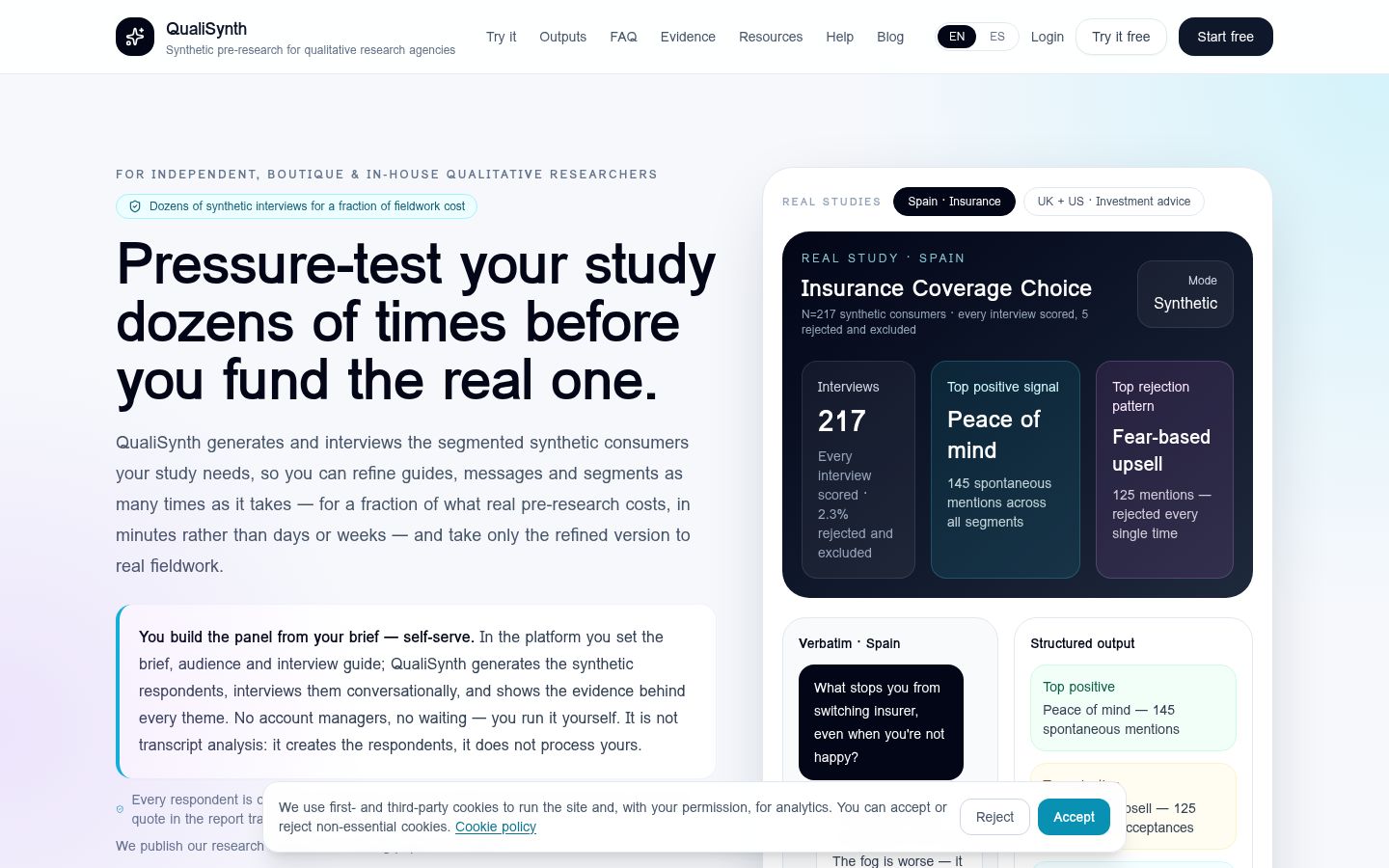
QualiSynth is a synthetic research tool designed for independent, boutique, and in-house qualitative researchers to generate and interview segmented synthetic consumer personas before conducting real fieldwork.
The platform operates through a self-serve brief interface where creators set the study audience, research goals, and interview guides. QualiSynth generates segmented synthetic respondents, conducts conversational interviews with them, and compiles thematic evidence where every insight links back to the transcript that produced it. According to published company findings, the engine has been back-tested against World Values Survey populations in the US and GB, and delivers agency-grade PPTX and PDF deliverables rather than simple dashboard readouts.
Growth teams use this workflow to pressure-test research guides, messaging angles, and audience segments dozens of times before committing budget to live human recruitment. By surfacing recurrent themes and rejection patterns, such as the fear-based upsell friction observed in European insurance studies, researchers refine their core positioning without incurring the high costs of traditional pre-research pilots.
The system stops being enough when teams need large-scale quantitative sample distributions or direct API driven synthetic research platform integrations for automated content publishing pipelines. Because QualiSynth focuses on conversational qualitative depth and document deliverables, content strategists seeking raw JSON survey datasets for programmatic GEO publishing will find its output format oriented more toward consulting presentations than automated database ingestion.
Viewpoints.ai: Evaluating Workflow Automation and Synthetic Audience Capabilities

Viewpoints.ai creates synthetic consumer panels and mock jury simulations to test survey concepts, messaging variations, and legal case strategies without traditional recruitment overhead.
The platform operates by building custom panel configurations where individual simulated jurors evaluate case facts, closing arguments, and exhibit changes. Founded by Stanford-trained media psychologists with extensive academic citations, the engine processes complex arguments through multi-agent interactions that simulate real human inconsistencies, ballot shifts, and deliberation dynamics. Empirical studies published by the platform indicate an 88 percent replication rate for medium and high effect sizes when compared against live human study results.
In-house trial counsel and brand strategists use this environment to evaluate verdict curves, identify plaintiff and defense drivers, and track how specific exhibit modifications move median damages distributions. The system outputs detailed visualizations and natural language reasoning behind every simulated vote, allowing legal and marketing teams to adjust their posture based on quantitative distribution ranges.
The platform ceases to be sufficient for B2B SaaS content creators who need broad demographic validation across income, occupation, and software purchasing budgets rather than legal venue simulations or mock jury deliberations. While its litigation and brand testing features excel in courtroom and high-stakes dispute scenarios, they lack the specific demographic and economic parameter controls required for product-led growth software content campaigns.
Head-to-Head Comparison Matrix: Data Provenance, API Flexibility, and Output Formats
| Capability | MoeVox | QualiSynth | Viewpoints.ai |
|---|---|---|---|
| Population Simulation Model Scale & Demographics | Simulated population model built from 100,000 real U.S. Census Bureau ACS PUMS demographic records | Segmented synthetic consumers built from user briefs and back-tested against World Values Survey populations | Custom panel configurations built for specific venues and case briefs |
| Statistical Output & Quantitative Validation | Structured reports containing winning options, driver rankings, response distributions, and top respondent concerns | Theme-to-quote evidence mapping, agency-grade PPTX and PDF deliverables, and interview transcripts | Verdict curves, damages distributions, juror vote reasoning, and visual rerun comparisons |
| Workflow Automation & Integration Options | Web application, credits-based pricing tiers, REST API, and AI prompt templates | Self-serve platform brief interface for conversational interview generation | Upload interface for case files, document questions, and panel configuration |
— means the vendor has not published this on official channels; it does not mean the capability is missing.
Conditional Decision Framework: Which Tool to Choose Based on Your Content Strategy Goals
Content strategists must match their validation platform directly to the operational demands of their publishing pipeline. When a SaaS growth team needs to generate citable first-party statistics, demographic income breakdowns, and raw Excel or JSON datasets via an automated REST API for SEO and GEO articles, choose MoeVox. Conversely, when a research team needs conversational qualitative transcripts, theme-to-quote tracking, and agency-grade PDF deliverables to refine interview guides before live fieldwork, choose QualiSynth.
When legal counsel or brand teams need mock jury simulations, deliberation tracking, and verdict curves for dispute resolution, choose Viewpoints.ai, accepting that its specialized focus will not supply broad software purchasing demographics.