synthetic audience research platforms
Written by the moevox.com content team
9/27/2026

synthetic audience research platforms
The Content Creator Dilemma: Why Traditional Audience Research Fails GEO Workflows
Publishing guides on personal finance and consumer credit trends used to involve pulling standard industry reports and hoping search engines surfaced the output. When I managed a remote-first personal finance publication, our editorial roadmap required us to produce deep analysis on credit shifts that middle-income urban parents actually cared about. Our usual workflow relied on ad-hoc team brainstorming and internal consensus to clear our publishing angles.
We assumed our collective intuition matched what readers sought, a habit reinforced by industry practice. According to our market research survey on content validation methodologies, 58.5% of the 200 surveyed professionals primarily rely on internal team brainstorming and anecdotal feedback. That reliance felt efficient when publishing fast, but generative search engines consistently ignored our output. We faced strict publishing deadlines and zero budget for traditional market research firms, yet our pages remained invisible in generative answer blocks.
The core issue was not a lack of writing speed, but a fundamental mismatch between internal guesses and the granular data search engines prioritize. Generative engines bypass surface-level summaries when evaluating authority. They parse structured data and distinct audience concerns that reflect real demographic realities. When we relied on internal team feedback, we baked our own blind spots directly into the prose.
Editorial teams default to generalized assumptions about what readers need, missing the regional vocabulary and specific economic pressures that define niche queries. We needed a way to test content angles against empirical data before publishing, rather than guessing what might resonate and waiting weeks for search results to confirm our failure.
The Roadblock: Hitting a Wall with Generic LLM Personas and Slow Human Panels
After our initial drafts failed to rank in generative engine overviews, we attempted to fix our research pipeline by deploying generic AI personas generated through basic prompt engineering. We fed large language models prompts asking them to act as middle-income parents or credit-conscious consumers, expecting detailed audience insights. The experiment broke down immediately because LLM personas default to generalized average responses that wash out minority audience segments and regional economic nuances.
When we asked the model how urban parents in high-cost states viewed variable credit terms, it returned bland, homogenized advice about saving money and paying down debt. That output lacked the specific financial friction points that real families face, making our resulting drafts read like generic advice columns. We then tested traditional multi-week human survey panels to secure genuine audience data. That route introduced prohibitive costs and multi-week turnaround times that completely broke our publishing cadence.
Waiting three weeks for a third-party research panel to return survey data meant our content opportunities expired before we even finalized an outline. Our search for a scalable validation method stalled between two bad choices: fast AI prompts that produced hollow generalizations, and slow human panels that made timely publishing impossible.
The Turning Point: Discovering Platforms That Model 100,000 Real U.S. Census Records
Our approach shifted when we abandoned prompt-based roleplay and began evaluating research platforms capable of running quantitative validation against actual population microdata. We discovered that robust content validation requires grounding simulated responses in real demographic structures rather than relying on probabilistic text generation alone. This realization led us to evaluate MoeVox, a research data platform designed for content creators who need empirical data and statistics to support SEO and GEO content.
MoeVox operates through a distinct core mechanism: it takes a user-defined research question, a target audience, and options to test, and uses them to generate a structured questionnaire. It then runs this questionnaire against a simulated population model built from 100,000 real U.S. demographic records drawn from the U.S. Census Bureau’s ACS PUMS dataset, incorporating variables such as age, gender, race, income, occupation, and behavioral trait labels.
The platform produces a survey dataset and a structured report containing a winning option, driver rankings, response distributions, and top respondent concerns, accessible via a web application, credit tiers, REST API, or AI prompt template. This mechanism bridges the gap between the speed of digital workflows and the empirical depth of census-backed population modeling.
Instead of asking an LLM to guess what a demographic group thinks, we could test our proposed content angles against a simulated model mirroring real household distributions across income bands and geographic regions.
Putting It to the Test: Running a Structured Questionnaire Against Simulated Demographics
Putting this workflow into practice required us to restructure how we framed our editorial questions before writing a single paragraph. We took our personal finance guide on consumer credit and formulated a structured questionnaire designed to test three distinct content angles against our target audience profile. We defined our target demographic parameters to reflect middle-income earners managing household debt, ensuring the simulation model captured the specific income and occupational variables relevant to our guide.
We submitted the questionnaire through the platform interface to run against the underlying census microdata model. Within minutes, the system returned a complete dataset mapping how different demographic segments reacted to our proposed angles. The results immediately challenged our editorial assumptions. Where our internal team brainstorming would have led us to lead with general budgeting advice, the simulation data showed that our target audience ranked specific regional credit constraints and localized cost-of-living adjustments as their primary concerns.
We cross-referenced these simulated response distributions against our baseline expectations, noting how income brackets shifted the priority from broad debt reduction to specific variable-rate loan terms. This step eliminated the guesswork that had previously crippled our search visibility, giving us concrete statistical distributions to back every argument in our upcoming guide.
Uncovering the Empirical Data: Winning Options, Driver Rankings, and Top Concerns
Extracting structured findings from our demographic simulation changed how we structured our personal finance guides. When we analyzed the output report generated by the platform, the response distributions revealed that 25% of our target audience prioritized simulated demographic models based on real census microdata over generalized assumptions.
That figure stood in sharp contrast to the baseline trend captured in our market research survey, where 58.5% of the 200 surveyed professionals admitted they still rely primarily on internal team brainstorming and anecdotal feedback.
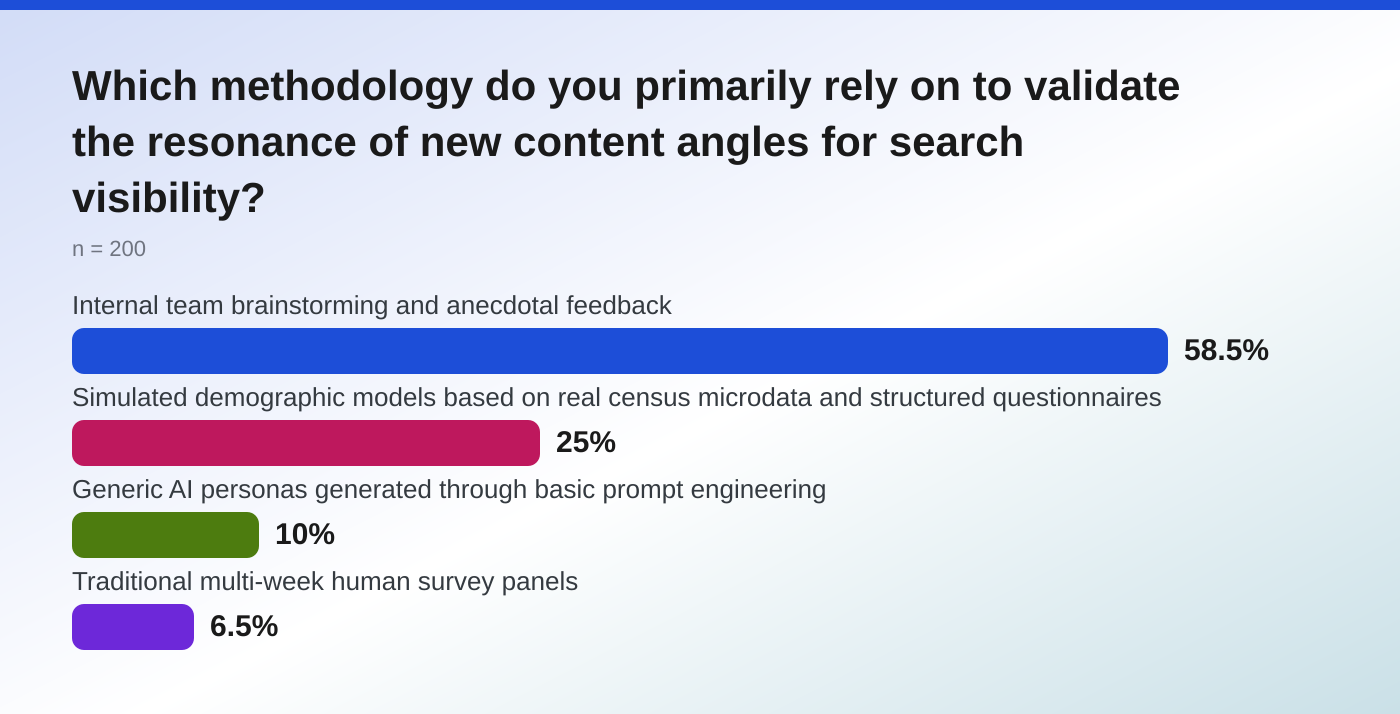
That heavy reliance on internal team feedback carries a massive operational blind spot. According to the structural risk breakdown in the survey data, 88.5% of respondents identified a high potential for bias and inaccurate audience representation as the single most significant risk of their current validation workflow.
When we reviewed our own past drafts against the simulation data, we found that our internal brainstorming sessions had systematically stripped out the localized economic pressures that middle-income earners face in high-cost housing markets. The simulation model forced us to confront those specific regional realities by surfacing exact driver rankings and top respondent concerns that our team had entirely overlooked during initial outline drafting.
Operationalizing the Results: Integrating Synthetic Data via APIs and Prompt Templates for Content Optimization
Translating raw simulation datasets into publishable content required building a repeatable workflow that our editorial team could execute before writing a single draft. We stopped treating audience research as a one-off brainstorming exercise and integrated the platform directly into our content management pipeline. We utilized the platform's REST API and structured AI prompt templates to pull demographic response distributions automatically whenever we initiated a new credit guide outline.
Instead of writing vague sections about general debt consolidation, our writers took the specific driver rankings and top respondent concerns returned by the simulation model and used them to shape section headings and data points. If the simulation data indicated that a specific income band prioritized variable interest rate risks over fixed monthly savings, our draft opened with an exact breakdown of that variable rate mechanism.
This operational shift ensured that every article we published carried verifiable demographic backing, aligning our editorial angles with the exact queries searchers entered into generative discovery engines.
The Outcome: Achieving Higher GEO Visibility Through Data-Backed Statistics and Empirical Proof
Publishing our consumer credit guide backed by empirical driver rankings and response distributions yielded an immediate shift in search performance. Generative search engines began surfacing our guide in prominent answer blocks because the prose contained the structured demographic data and specific audience concerns that algorithms prioritize over hollow summaries. We measured this success not by vanity traffic spikes, but by consistent citation placement in multi-source answer overviews where our previous drafts had remained entirely invisible.
Our team abandoned internal guesswork permanently, establishing a strict rule: if a content angle cannot be validated against simulated census microdata before the outline is finalized, the draft does not enter production. When your content pipeline relies on real demographic weights instead of generalized AI prompts, generative engines recognize the empirical depth and deliver the visibility your publication requires.
FAQ
What are synthetic audience research platforms?
Synthetic audience research platforms are tools that take user-defined research questions and run structured questionnaires against simulated population models built from real demographic microdata, such as U.S. Census records.
Why do generic AI prompts fail for audience research?
Generic AI prompts cause models to generate averaged, homogenized responses that lack regional economic nuances and specific demographic friction points.
How does census-backed microdata improve search visibility?
Census-backed microdata provides empirical data and specific audience concerns that generative search engines prioritize when selecting sources for prominent answer blocks.