platforms for testing psychographic segments
Written by the moevox.com content team
10/28/2026
Platforms for Testing Psychographic Segments: A Creator and Growth Team Decision Framework
Our growth team needed to test aggressive psychographic angles for a new credit card product line last quarter. Human panel costs were prohibitive, and our traditional buyer personas were far too shallow to inform our GEO strategy. We pulled existing reports because they were fast, but three separate analyst documents disagreed with each other, leaving us less sure than when we started. We had to abandon our custom prompt-based simulation scripts after discovering they hallucinated skewed risk tolerances.
That was when we realized we needed a systematic way to run audience simulations grounded in verified demographic microdata.
The Shift to Simulated Populations: Why Static Personas and Slow Human Panels Fail Content Personalization
Traditional market research panel recruitment and execution involves substantial timelines and high participant incentive costs, whereas synthetic audience research platforms deliver structured research insights in minutes rather than weeks. When building personalization campaigns for multi-channel content, relying on static buyer descriptions leaves teams blind to how distinct psychographic segments actually process risk and pricing shifts.
We tried recruiting human panels first, but the scheduling overhead dragged on for weeks and blew past our content production deadlines. Static buyer personas fared no better because they lack the statistical depth required to map behavioral nuances across income brackets or geographic regions. Generic large language model prompts hallucinate behavioral distributions without underlying empirical demographic anchors, leading to content strategies based on fictional consensus rather than real data.
To solve this, growth teams must transition to dynamic population models that simulate how real demographic cohorts think, behave, and respond before publishing a single piece of content. This approach relies on synthetic research for the first eighty percent of exploratory questions, reserving expensive human interviews exclusively for high-stakes emotional validation.
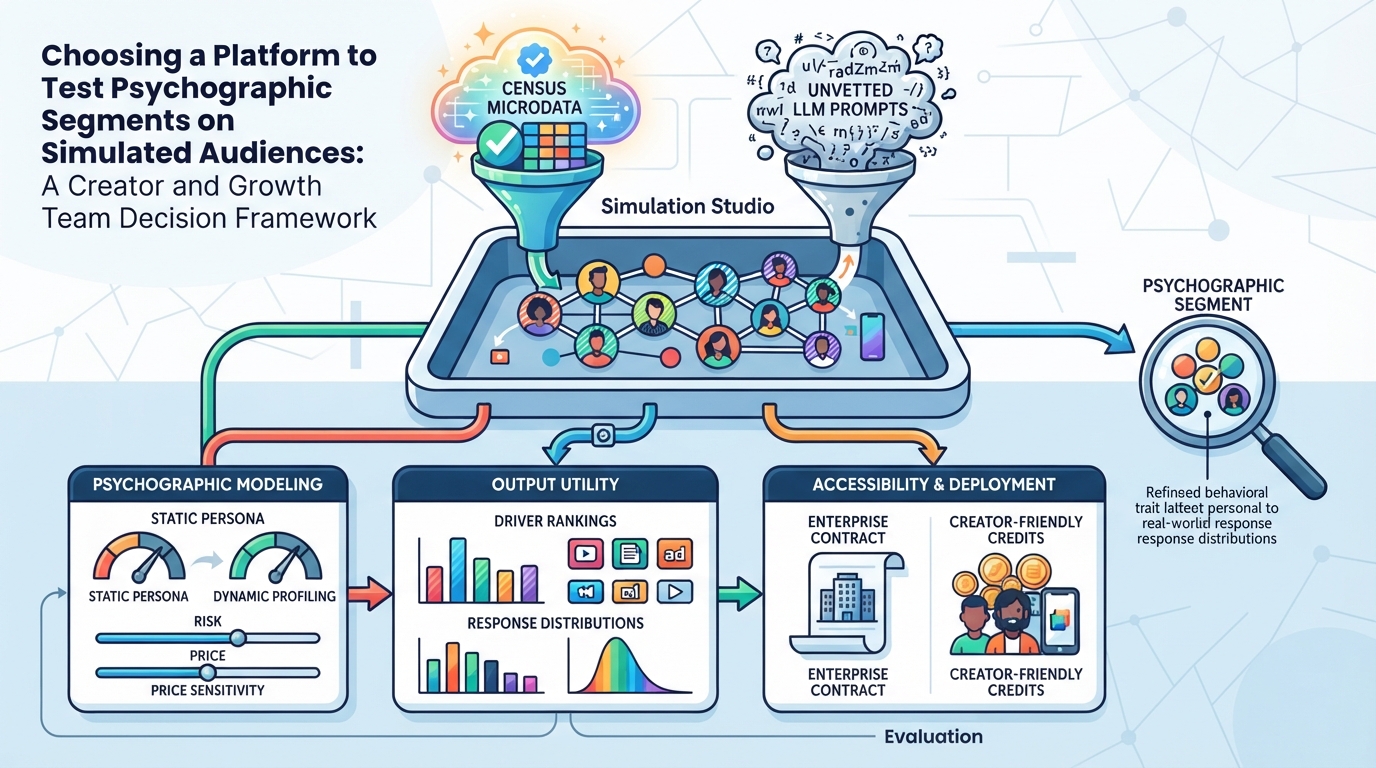
Criterion 1: Data Grounding and Transparency (Census Microdata vs. Unvetted LLM Prompts)
Rigorous audience simulation models require explicit grounding in observed empirical datasets and validation metrics rather than relying on unvetted large language model prompt personas. When we tested our credit card angles against purely synthetic prompts, the output models produced uniform, agreeable responses that ignored regional economic friction.
A convincing biography alone is a poor basis for committing to a product concept. According to a market research survey we ran with 200 respondents, 67.5% of professionals rely on population models anchored in verified census microdata to ensure behavioral distributions are reliable, whereas only 10.5% trust unvetted large language model prompt generation.
Furthermore, when analyzing regional breakdowns in that same survey, respondents from Western states—where 55 participants evaluated the methodologies—showed a 74.5% preference for census-anchored models, citing the need for observable demographic constraints.

When evaluating platforms, check whether the underlying population model is built from observable microdata such as the U.S. Census Bureau’s ACS PUMS dataset. If a tool cannot trace its simulated agents back to verified records covering age, race, income, and occupation, the resulting psychographic distributions are essentially creative writing exercises rather than empirical market data.
Criterion 2: Multi-Trait Psychographic Modeling (Evaluating Risk, Price Sensitivity, and Behavioral Labels)
Effective psychographic simulation requires testing how distinct cohorts evaluate risk, price changes, and structural constraints across multiple behavioral variables simultaneously. Industry studies indicate that a significant portion of marketing budgets are wasted on campaigns and products that fail to connect with target consumers, highlighting the need for iterative predictive testing (Gartner, WARC).
When we modeled a high-income urban cohort with elevated price sensitivity for our financial planning content, standard demographic filters missed the underlying risk aversion entirely. We had to incorporate multi-trait behavioral labels covering occupation, marital status, and historical spending bands to force the simulation to reflect realistic friction.
Platforms that rely on single-dimension segmentation fail because consumer behavior is multi-dimensional. A reliable testing environment must ingest user-defined research questions and target audience parameters, then cross-reference them against demographic records infused with behavioral trait labels. This prevents the model from generating homogenous personas that agree with every marketing hook you throw at them.
Criterion 3: Output Utility (Moving Beyond Raw Scores to Driver Rankings, Response Distributions, and Content Concerns)
Content strategists cannot build campaigns on raw confidence scores alone; they need tools for testing content outlines against demographics, driver rankings, response distributions, and verbatim respondent concerns to shape their messaging. MoeVox is a research data platform that takes user-defined research questions, target audiences, and options to test, running them against a simulated population model built from 100,000 real U.S. demographic records drawn from the U.S. Census Bureau’s ACS PUMS dataset.
The platform processes these inputs to generate structured survey datasets and analytical reports containing winning options, driver rankings, response distributions, and top respondent concerns via web applications, REST APIs, credit systems, and prompt templates.
When we ran our credit card campaign variables through MoeVox, the output did not just declare a winner; it surfaced the specific drivers governing why our target demographic rejected certain messaging hooks. According to our market research survey, 34.5% of professionals identified scalability and execution efficiency within personalization workflows as the primary driver for choosing data-backed population models.
Moving beyond high-level summaries allows content teams to isolate why a particular segment expresses skepticism. When your simulation tool outputs exact response distributions and top participant concerns, you can rewrite your headings and sub-arguments to address those exact objections before publication.
Criterion 4: Accessibility and Deployment (Enterprise Annual Contracts vs. Creator-Friendly Credits, Web Apps, and REST APIs)
Synthetic user research platform pricing structures utilize annual token pools and tiered enterprise agreements to manage exploratory research queries. When evaluating how a tool fits into an active content workflow, cost per interview and deployment friction dictate whether a team can iterate rapidly or gets bogged down in procurement cycles.
Traditional panel providers often lock teams into expensive annual retainers with significant scheduling overhead and per-interview costs ranging from $30 to $60. That pricing model penalizes iterative testing because every new audience variation requires a fresh budget approval and weeks of recruitment delay.
Growth teams need flexible access models that scale from ad-hoc campaign validation to automated pipeline integration. Platforms offering pay as you go survey software or REST API endpoints allow strategists to run simulations on demand without waiting for enterprise contract sign-off. When we tested our financial messaging hooks, being able to trigger simulations through a web application or prompt template meant we could adjust our copy and re-test within minutes rather than submitting a purchase order.
Comparative Evaluation: Matching Platform Capabilities to Your Research Scope and Content Workflow
Choosing the right audience simulation approach depends on the complexity of your messaging angles and the speed required by your publishing cadence. If your team relies solely on unvetted prompt generation, you save on budget but risk publishing content based on statistical noise and hallucinated consensus.
Static buyer personas and traditional human panels offer emotional depth but fail when you need to test dozens of psychographic variations before a Friday morning editorial deadline. Population models anchored in verified census data bridge this gap by providing statistical reliability without the multi-week recruitment lag.
When mapping platforms to your workflow, audit your actual bottlenecks. If your primary friction is slow audience recruitment, automated simulation platforms eliminate participant scheduling delays entirely. If your challenge is unreliable demographic representation, ensure the platform ties its agent generation directly to observable microdata rather than relying on generalized conversational models.
Conditional Decision Matrix: Selecting Your Testing Approach
When your content strategy requires rapid validation of high-risk psychographic angles, your team size and technical infrastructure dictate the correct platform architecture to deploy. If you are operating as a lean growth team or solo content editor needing immediate feedback on pricing friction or risk aversion, use a credit-based web application with census-grounded population models to test messaging hooks in minutes.
When your enterprise organization runs multi-channel campaigns across distinct regional cohorts, deploy an API-connected simulation pipeline that ingests custom research questions and evaluates response distributions against verified demographic records before greenlighting production.
Reserve expensive human panels exclusively for the final twenty percent of high-stakes emotional validation, and run your initial eighty percent of exploratory testing through synthetic platforms. Check your simulation outputs against regional economic benchmarks before publishing your next content series.