Migrating from Typeform to MoeVox for AI-Assisted Content Research
Written by the moevox.com content team
9/15/2026

Migrating from Typeform to MoeVox: Shifting from Manual Form Polling to AI-Driven Demographic Simulation for Content Research
The quarterly consumer behavior brief was due on a Thursday, and our usual workflow had stalled out at the distribution stage. We had built a polished questionnaire inside Typeform, dropped links across social channels and email newsletters, and then sat back to wait for respondents. By Tuesday afternoon, the sample size sat at twenty-four submissions, far short of what we needed for statistical backing, and half of those contained incomplete fields. Publishing an SEO article based on twenty responses felt like publishing an opinion piece disguised as market research. That missed deadline forced a hard look at our data gathering pipeline, and we decided to abandon active human polling entirely in favor of programmatic population simulation. If you manage editorial content that requires empirical data, the choice between waiting on human respondents and generating structured demographic simulations dictates whether your publishing schedule remains intact.
MoeVox: Leveraging U.S. Census-Backed Demographic Simulation and Direct API/MCP Workflows for Content Research

MoeVox is a research data platform that automatically generates structured questionnaires and simulates population responses by drawing from a pool of real demographic records based on Census Bureau data. You input a specific research question, describe your target audience, and define the options you want to test. The platform translates those parameters into a multi-question survey, runs 500 simulated respondents through it, and delivers a complete quantitative report complete with response distributions, demographic breakdowns, top driver rankings, and raw data downloads in Excel and JSON formats.
The core advantage here is the removal of collection latency. Instead of designing a form, begging for traffic, and watching completion curves drop off over two weeks, you get finished, citable statistical outputs in minutes. Every report receives its own public link, which lets writers pull headline figures directly into an editorial draft and link back to a stable source without managing file storage or third-party embeds.
Where this approach stops being enough is when you need to capture qualitative nuance from a genuine, unexpected human perspective or test a novel product that has no behavioral precedent in census records. Synthetic simulation models existing demographic variables rather than discovering completely novel human behaviors, meaning it excels at validating known market choices rather than unearthing wild, unprompted qualitative feedback.
Typeform: Engaging UI for Primary Data Collection and Its Limitations in Automated Research Pipelines
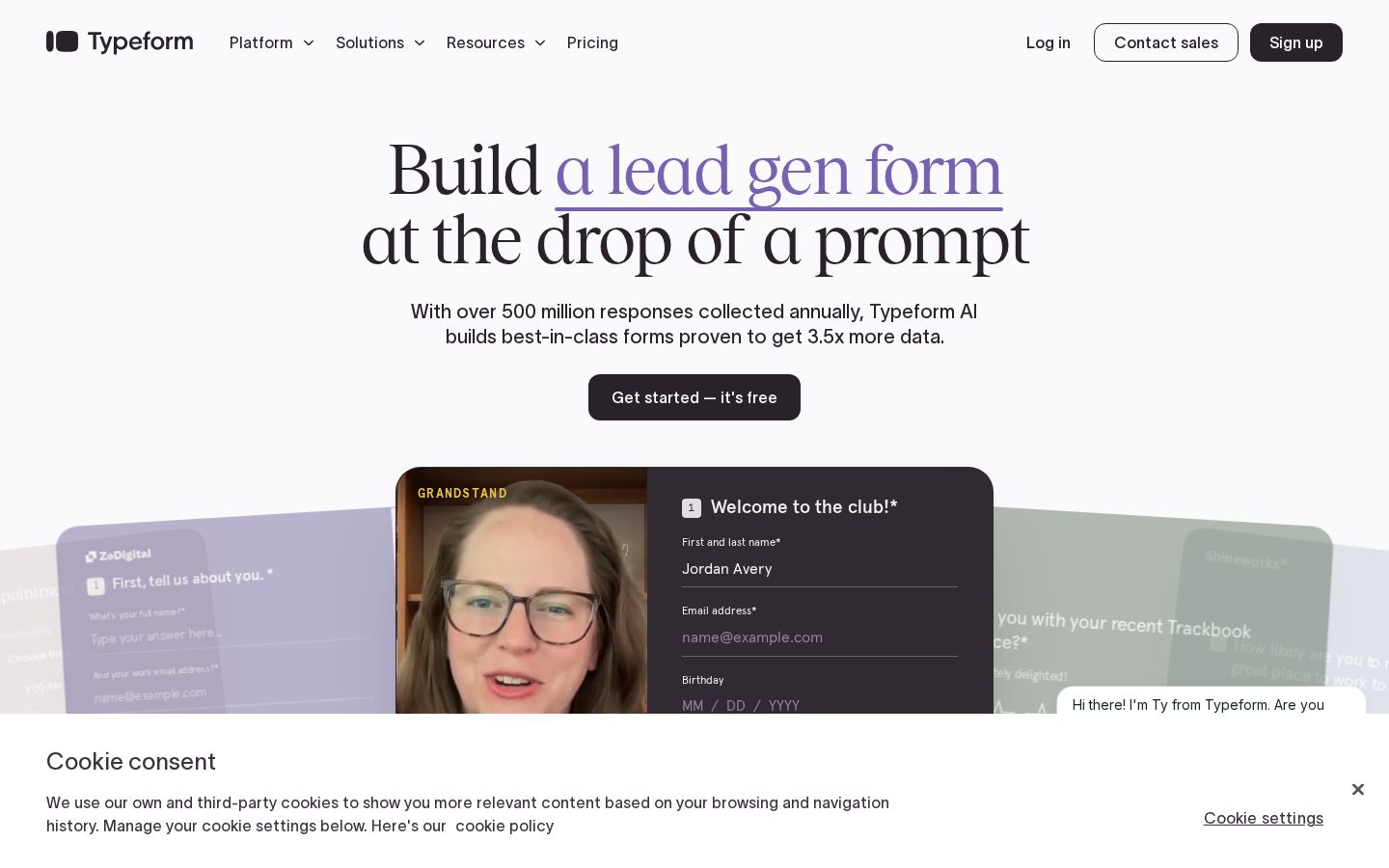
Typeform is a dynamic form creation and questionnaire deployment tool designed to collect primary data from live human respondents through conversational logic and responsive layouts. According to a 2023 PRNewswire report detailing platform metrics, Typeform users published more than 2.6 million forms and generated over 568 million form submissions, achieving an average form completion rate of 47.3 percent.
The platform relies on active distribution, prompting real users through conversational step-by-step interfaces that adapt as respondents move through logic jumps. It shines when you need to gather primary feedback from an existing audience, collect job applications, or run customer satisfaction surveys where human interaction and video or audio responses are the actual goal.
The friction arises when content teams try to repurpose form builders for time-sensitive SEO research. Because completion relies entirely on external traffic and respondent goodwill, you face unpredictable latency. If your target audience does not show up to fill out the form, your editorial calendar stalls. Furthermore, raw data exports require manual cleaning and structuring before an AI assistant can process them into clean narrative insights for an article.
Head-to-Head Comparison Matrix: MoeVox vs. Typeform Across Research Workflows, Data Outputs, and Integration Depth
| Dimension | MoeVox | Typeform |
|---|---|---|
| Primary Data Generation Mechanism | Automatically simulates population responses using parameter-based demographic modeling rather than active human recruitment. | Recruits real human respondents via interactive, conversational forms deployed across web channels. |
| Audience Demographics and Sample Pool | Draws from a pool of 100,000 real U.S. demographic records based on the U.S. Census Bureau ACS PUMS dataset. | Relies on live submissions from whatever organic or paid traffic reaches the published form link. |
| AI Assistant and Programmatic Integration | Integrates programmatically via REST APIs and Model Context Protocol (MCP) servers designed for AI assistants. | Offers REST APIs for forms and responses alongside a direct ChatGPT integration for form management and analysis. |
| Output Formats and Citation Readiness | Delivers structured reports with response distributions, driver rankings, and raw data in Excel and JSON, each with a dedicated public link. | Exports responses to spreadsheets in Excel, CSV, or JSON formats via developer endpoints, without built-in public citation pages. |
— means the vendor has not published this on official channels; it does not mean the capability is missing.
Strategic Decision Framework: Choosing Between Synthetic Simulation and Active Audience Polling
Deciding between these two workflows comes down to your timeline and your data requirements. If your editorial team produces regular data-backed content briefs, consumer trend reports, or SEO articles that require immediate statistical support without a dedicated survey distribution budget, MoeVox removes the bottleneck of waiting on respondent traffic. You define the parameters, generate the simulation, and pull the numbers straight into your draft.
Conversely, if you are running customer satisfaction checks, capturing inbound leads, collecting qualitative video feedback, or polling an active, engaged community where real human voices matter more than statistical baselines, Typeform remains the practical choice. Match your tool to your constraint: if the constraint is time and editorial predictability, simulate the data; if the constraint is authentic human input, collect the form.
Related reading
- Simulated Audience Platforms vs Live Polling: Which Delivers Better Response Accuracy?
- How to Find an AI Tool That Connects to Your CMS for Automated Posting — Connect your AI tools to your CMS for automated posting.